Tudhoe & Spennymoor Local History Society
Soiree at Ferryhill - On Thursday 3rd January a grand soiree was held in the Public School, Ferryhill to celebrate the opening of Ferryhill and Little Chilton Circulating Library & Literary Institute. Over 250 people attended for tea. The room was decorated with evergreens and artificial roses, hung in festoons all round the walls. Six large mistletoes hung from the ceiling, underneath each a beautiful camphine lamp reflecting splendour on the whole. The most prominent feature was (over the fireplace) a large crown of hollies, studded with roses:- underneath, in large characters, the letters “VR”, tastefully worked with hollies.
At 4pm catering was conducted by ladies of the village and surrounding neigbourhood in a very professional manner, ladies were from the Alderson, Aubrey, Johnson, Lawson, Mawe, Robson, Rudd, Thompson, Walker and White families. A number of pitmen from the colliery were present, whose appearance and conduct entitled them to much respect.
At 6pm after the tea tables were removed a platform was erected and seating for over 400 people. Rev. D. Bruce chaired the several speeches which dwelled upon the necessity for similar institutions in every large community. Mr Barras, of Little Chilton Colliery, who principally set up the Institute read a report to show subscriptions of £45 had been raised to continue with the work. Some of the contributors were Lord Bishop of the Diocese, Lord Henry Vane MP , Mr Farrer MP, Sir William Eden and Mrs Surtees from Mainsforth. Sedgefield Church choir attended.(12th Jan 1850 Gateshead Observer, 18th Jan 1850 Durham County Advertiser, 25th Jan 1850 Durham Chronicle)
In The History and Antiquities of the County Palatinate of Durham, etc.. Vol.I, p. 443., 1857 by W. Fordyce, it says:-
"The Ferryhill and Little Chilton Colliery Mechanics' Institute" was established at the latter place in 1850. The number of members soon amounted to 70; but there are at present only 30. There are from 700 to 800 well-assorted volumes in the library, which have been accumulated at a cost of upwards of £100. Each member pays a subscription of one penny a week, and ladies are admitted at one shilling per quarter. Private subscriptions are given by the owners of the colliery, William Bacon, Esq., of Chilton Hall, and the Rev. David Bruce, of Ferryhill. A soiree, in aid of the funds, was held at Christmas, 1852, in the National School Room; in which, as well as in the library room at Little Chilton, lectures are occasionally delivered.
The existing Dean Bank & Ferryhill Literary Institute was built as part of the Dean Bank development in 1908, it was refurbished in 2001 after five years of fund raising.
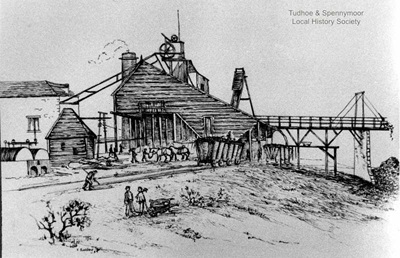 Mysterious Accident - An inquest was held at the Wheat Sheaf Inn, New Spennymoor, on Monday last, before William Trotter Esq, coroner, to investigate the cause of death of Ralph Haydon, a pitman, working at Whitworth Colliery. The principal evidence was that of George Adamson, who deposed as follows:-“I am an onsetter at the bottom of the shaft of the Whitworth colliery. Yesterday, about 6 o’clock in the evening, I was setting the workmen up the shaft, the colliery having done work for that day. The deceased was in the cage, with six or eight other men, and I was just going to pull the rapper for the engineman to draw the cage up when a metal chair came down the shaft, and struck the deceased upon the left side of the head. The other men got out of the cage, and deceased fell down. I took hold of him, but he appeared quite dead. He never spoke or moved. I put him into a tub, and sent him to bank. I don’t know where the chair came from. I did not hear it until it hit the deceased.
It touched nothing as it came down. It was a railway chair, and might be about 8lbs weight.There was a larger chair in the sump at the bottom of the shaft, but it was there this morning. I don’t think it could have stuck to the ascending cage.”
Thomas Dobby, a banksman, and others, were also examined as to how the metal chair had fallen down, but nothing satisfactory could be elicited; none of the witnesses being able to account for it. The evidence being thus incomplete, the coroner considered it his duty to adjourn the proceedings, as the unfortunate occurrence appeared so far veiled in mystery. The court was therefore adjourned to Saturday, at three o’clock in the afternoon.
The Colliery Accident at New Spennymoor - The adjourned inquest on the body of Ralph Hayson was held on 19th inst. Before Wm Trotter, Esq, according to appointment. No further evidence, however, was produced to show from whence the metal had come which fell on the head of deceased. Mr Patrick, the resident viewer, deposed that he had used every means to bring it to light, but without success, but he did not think it had been done wilfully or maliciously.
Verdict – “That the deceased died from a mortal wound on the head, caused by the falling of a metal chair, while ascending the shaft; but how it had fallen, there was no evidence to show.” (19th/26th Jan 1850 Newcastle Guardian and Tyne Mercury, 25th Jan 1850 Durham Chronicle)
Great Chilton Farm To Be Let – and entered upon at May next.
Great Chilton Farm, in the Occupation of Messrs Baker and Son, containing about 308 acres, of which upwards of 130 acres are valuable Old Grass, and the chief Part of the Arable is capital Turnip Soil.
Chilton is within one mile of the Turnpike Road between Durham and Darlington, and about the same distance from the Ferryhill Station, thus affording to the Tenant every facility for conveying the farm produce to market, and obtaining Lime and Manure at a moderate expense.
The tenants will send a person to show the farm, and Terms of Letting may be known on application to M. Ryle, of Moorhouse, near Durham. January 30th 1850. (2nd February 1850 Newcastle Journal)
To Be Let
And entered upon at May-day next,
A Farm at Ferryhill, containing 100 Acres, more or less.
For further particulars apply to Mr Raine, Ferryhill.
Ferryhill, February 20th, 1850.
(22nd February 1850 Durham County Advertiser)
To Be Let And may be entered on at May-day next,
A Large and Commodious INN, situate at TUDHOE, and known by the sign of the “GEORGE AND DRAGON”; with a BREWERY adjoining; capable of brewing 14 Half-Barrels. A Malt-Loft, Porter-Vault, Cellar, Stable, and other Outbuildings convenient for the trade, attached.
For further particulars, apply to MR JOHN PICKERING.
Tudhoe, Feb 5, 1850
(15th February 1850 Durham Chronicle)
In 1851 the licensee was Mathias Starforth (b1811).
In 1853 The George and Dragon with adjoining brewery was offered for sale with or without a well built dwelling house of 7 rooms, dairy and other conveniences. They promoted it by stating: The Tudhoe Iron Works being within a short distance, and the population rapidly increasing, it would be a good investment to a man of capital. For particulars apply to Mr John Pickering, Tudhoe Mill.
The property was then offered for auction on 29th March 1854. It was described as an Inn with 10 rooms, cellar, and bar, the brewery, a stable with three stalls and loose box. A dwelling house with 7 rooms, wash house, and coalhouse, now in the occupation of Mrs Hoggett, as tenant. Close to Tudhoe Iron Works and Whitworth Collieries and are held for a residue of a term of 1,000 years, created by indenture of demise, dated the 5th day of July, 1802. The owner is Mr John Pickering.
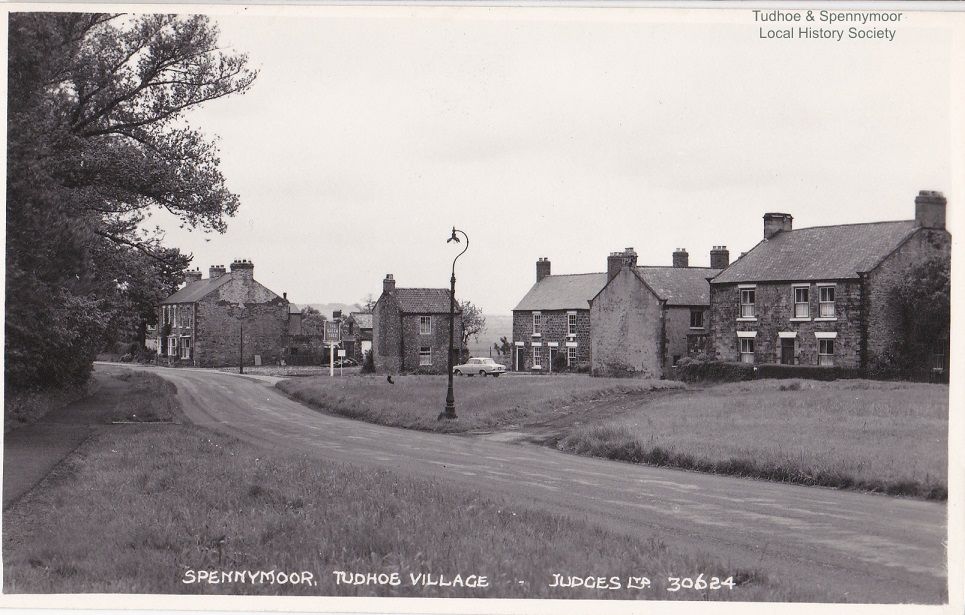
The Inn was advertised to let in November 1857 and February 1858. In April 1858 it was to be let with a small field of rich old grass land, butcher’s shop, stable and cow byer by John Pickering Tudhoe Mill. In 1860 it was to let by Jonathan Pickering, Spirit Merchant, Tudhoe.
On 28th July 1863 the Inn, Brewery, Yard and Out Offices, now occupied by William Adamson, also a dwelling house, nearly adjoining the Inn, with two stables, garden and a grass paddock behind, occupied by Widow Pinkney, were to be sold at auction.
It is believed the property was sold and closed as licensed premises and used as accommodation by the Reverend Blunt who was curate at St Brandon’s Church, Brancepeth. It is now a residential property called Ivy House.
(Public Houses of Spennymoor and Neighbourhood by Bob Hall, Newcastle Courant 16/09/1853, Durham County Advertiser 26/02/1858,
Durham Chronicle (10/03/1854, 27/11/1857, 30/04/1858, 02/11/1860, 10/07/1863))
High Butterby, near Durham
To Be Let and entered upon at May-day next,
The Farm at HIGH-BUTTERBY, in the Township of Sunderland Bridge, containing 181 acres of Arable, Pasture and Meadow Land.
ALSO, 16 acres of Meadow-Land and 50 acres of Woodland, at present occupied with the above Farm.
High Butterby is about 3 miles from the City of Durham, and in the immediate neighbourhood of the High Turnpike Roads communicating with the Market Towns of Durham, Darlington, Stockton, and Bishop Auckland. The York, Newcastle, and Berwick Railway runs within a few yards of the eastern part of the farm.
For further particulars apply to Mr. Edmund Hoggett, Croxdale-Wood House, near Sunderland Bridge.
Croxdale Wood House, Nov. 14th 1849.
(8th February 1850 Durham Chronicle)
Croxdale Estate Timber
To be Sold By Proposal. (In One Lot)
The following valuable timber, standing and growing on the Croxdale Estate, near Durham:-
On the Low Burn-Hall Farm and Plantations:
54 Oak, 28 Cyphers, 20 Ash, 2 Cyphers, 8 Elms, 2 Cyphers, 5 Silver Firs, 17 Cyphers3 Poplars, 14 Larch, 5 Cyphers, 5 Spruce Fir Cyphers.
In the Lady-Park Plantations: 15 Oak 56 Cyphers, 3 Ah, 2 Cyphers, 14 Larch. 1 Cypher, 1 Scotch Fir Cypher, 1 Willow Do, 1 Beech Do, 2 Elm Do.
Sealed proposals to be sent to Mr Edmund Hoggett, Croxdale Wood House, near Durham, on or before Tuesday, the 19th of February, 1850, who will attend on that day, at the Three Tuns, New Elvet, Durham, from three o’clock till five, to receive the same.
Nine months’ credit will be given on approved security; the Parties tendering for the Purchase of the Wood to name in their Proposals the persons they intend for sureties.
The purchaser will have to pay down a deposit of Five per Cent. Immediately after the Sale.
Croxdale, Feb 7th, 1850
(15th February 1850 Durham Chronicle)
Edmund Hoggett
At Croxdale Wood House, on the 20th inst. suddenly, aged 76, Mr Edmund Hoggett, many years a land agent for the late and the present Mr Salvin.
(23rd February 1850 Newcastle Guardian and Tyne Mercury)
Edmund Hoggett (1775 Manfield-1850) was married to Ann Thompson (1778 -1857) in 1804 at Stanwick St John and in 1841 they were living at Croxdale Wood House, Sunderland Bridge, on the Salvin estate where Edmund was land agent. Also living there are their three daughters Elizabeth, Monica and Mary. They had four sons and four daughters, the eldest daughter Ann married Jonathan Pickering in 1837, a spirit merchant who attended at the death of Edmund. He was owner of the George and Dragon Inn in 1850/60s.
In 1851 Ann Hoggett, widow living on interest, aged 72 with her daughter Mary, aged 30, was living next door to Mathias Starforth who was licensee at the George and Dragon Inn at this time. They are in the dwelling house linked to the Inn, owned by her son-in-law, in 1853 when it was offered for sale it stated now in the occupation of Mrs Hoggett, as tenant (see George & Dragon Inn above).
Farms to be Let, Tithe Free, on Lease or otherwise - And entered upon at May-day, 1850.
Farewell-Hall-North Farm, in the Township of Elvet Barony, Durham, containing 78 acres, more or less, of Arable, Meadow, and Pasture Lands, situated only 1 mile from the City of Durham, on the Darlington Road. The Rent will be low to an improving tenant.
Thinford Farm, near Ferryhill, Durham, containing 90 acres, more or less, of Arable, Meadow, and Pasture Lands. Nearly all the Tillage Lands have been thoroughly drained, and well Limed.
Further particulars may be known on application to Mr W Fleming, Land Agent, Tudhoe, Durham
Tudhoe, Feb 27th 1850. (1st March 1850 Durham Chronicle / 22nd March 1850 Durham Chronicle)
TO BE LET
And may be entered upon immediately.
All those valuable COAL MINES, and SEAMS of COALS, in the Tudhoe Estate, in the Parish of Brancepeth, in the County of Durham, containing about 1700 Acres.
This Coal Field is situated within a short Distance of the York, Newcastle and Berwick Railway, and the West Durham Railway passes over Part of the Estate.
Further particulars may be known on Application to Mr Benjamin Arkless, Colliery Viewer, Tantoby, Chester-le-Street. Tantoby, Feb, 28, 1850.
(8th March 1850 Newcastle Courant)
To BE SOLD BY AUCTION
At the House of Mrs Dawson, in Merrington, in the County of Durham, on Tuesday, the 2nd day of April, 1850 at Two o’clock in the Afternoon.
Mr Shanks, Auctioneer,
In such lots as shall be named on the day of Sale,
All that substantially built DWELLING-HOUSE, suitable for a Residence, with a large GARDEN in front of the same, and a Stable Cow Byer, and other conveniences, as lately occupied by Mr John Henderson.
Also FIVE other DWELLING-HOUSES, near the above, with a large BUTCHER’s SHOP, in which a well established business has for many years been carried on.
Also a large piece of GARDEN GROUND, fronting the Town Street of Merrington, suitable for building purposes; and a Garth, containing an acre of excellent Grass Land.
The above premises are held for the unexpired residue of a Lease of 21 years, under the Dean and Chapter of Durham. But they may be considered nearly equal to freehold, as a fixed sum of £9 only is paid on each Renewal.
Mr John Henderson will show the premises; and further particulars may be obtained on application to Mr George Atkinson and Mr William Lidster, of Merrington; at Messrs Burrell, Shafto and Greenwell’s, Solicitors, Durham; or to Mr Bowser, Solicitor, Bishop Auckland.
(22nd March 1850 Durham Chronicle)
NOTICE TO THE PUBLIC.
CHRISTOPHER TODD, of Byers Green, near Bishop Auckland, who has been very successful for the last Eight Years in curing several Individuals of Cancers, Tumours, etc., without the painful Operation of Cutting, will attend at Mr Eden’s Innkeeper, High Street, Gateshead, on Saturday, March 30th, 1850.
(8th March 1850 Newcastle Courant)
Christopher Todd ( b1819 Byers Green – 1882) was the son of Thomas Todd, a blacksmith, and Catherine. In 1842 he married Mary (b1819 Lamesley) and in 1851 they were living in Byers Green with five children, John, Jane, Thomas, Elizabeth Ann and Margaret. Christopher was a blacksmith but is also treating cancer patients.
In 1861 Christopher states his occupation is “Cancer doctor”, they have two more children William and Robert. In 1871 he is a “Serjecal doctor” and his sons Thomas and William are blacksmiths.
By 1881 his wife Mary has died and Christopher’s occupation is “Doctor”, his son William is a blacksmith and Robert is a butcher. Daughter Jane is also living with them, she has married Thomas Nattress, a farmer, and has three children Walter, Joseph and Mary.
In 1891 Jane was a widow living in School Row, Byers Green, with her three children, brother John who is a “Practitioner (unqualified)", and brother Robert a cartman.
Durham Spring Assizes Crown Court
HENRY TATE (27) was charged with having at the township of Whitworth, feloniously wounded Richard Magee, with intent to maim him. Mr DAVISON stated the case. Prosecutor and prisoner were pitmen at Spennymoor, Prosecutor was what is called a “Master’s Man”. On the 17th of November last, Magee went to Wallis’s public-house in the village. Prisoner was there, and said he would have nothing to do with a master’s man; upon which prosecutor replied, “that if he said that again he would skelp his mouth”. Prisoner made no more to do but took up the poker and struck prosecutor three severe blows over the head with it, felling him to the ground. A medical man had to be sent for, and prosecutor was long in a weak condition. Guilty.
Sentenced to three months’ imprisonment, he having been in prison three months already. The court rose at half-past five.(9th March 1850 Newcastle Guardian and Tyne Mercury)
Inquest at Merrington
An inquest was held at Merrington, on the 16th instant, before William Trotter, Esq., on the body of Elizabeth Milner, wife of Robinson Milner, of Merrington. The husband of the deceased left her to go to Ingleton on the 13th, and on his return, in the afternoon of the following day, he found the door fastened, and the windows shut in. The door was forced open, and he found deceased in bed with her night-dress on. She was speechless, and appeared insensible. Mr Clark, surgeon, of Ferryhill, was sent for, and applied leeches to her temples, and a mustard poultice to her feet, but without success, She died about six o’clock the same evening. She was quite well when her husband left home. She had only been married in December last. Verdict “Natural death.”
(22nd March 1850 Durham Chronicle)
Elizabeth Milner (nee Lawson) died on 15th March 1850, aged 29, cause of death "Unknown, found in bed in a dying state, not certified". Her husband was a butcher.
CHEAP TRIP TO YORK AND LEEDS.
It will be seen, on reference to an advertisement in a succeeding column, that a cheap trip has been projected from this neighbourhood for three or five days to York and Leeds on Easter Monday. An opportunity will be thus afforded to those who have Easter holidays to enjoy to pass them both pleasantly and profitably. Parties from Durham will be required to proceed to the Ferryhill station, either by the first or second trains on Monday morning. (29th March 1850 Durham Chronicle)
CHEAP TRIP! - DELIGHTFUL EXCURSION
For Three and Five Days, from HARTLEPOOL, CASTLE EDEN, TRIMDON, FERRYHILL, MIDDLESBOROUGH, STOCKTON, DARLINGTON, RICHMOND, NORTHALLERTON AND THIRSK
TO YORK AND LEEDS, AND BACK.
The public are respectfully informed, that a Special Train will start from Hartlepool, on EASTER_MONDAY, APRIL1, 1850, at half-past Eight o’clock in the morning; and will stop at Castle Eden and Trimdon; at Ferryhill, for Passengers from Durham, Middlesborough, and Stockton; at Darlington; at Dalton Junction, for Passengers from Richmond; at Northallerton, for Passengers from Bedale; at Thirsk; at Pilmoor Junction, for Passengers from Boroughbridge; thence to York and Leeds.
On Wednesday APRIL 3rd, and on FRIDAY, April 5th, Trip Passengers will return from Leeds, at Twelve o’clock at Noon on each Day. The train will stop at all the Stations as on going; will arrive at York about Two o’clock; at Darlington and Ferryhill about Four o’clock; and at Hartlepool about Seven o’clock on each Evening.
Fares from Hartlepool, Castle Eden, Trimdon, Ferryhill, Stockton, Darlington, Richmond, Northallerton, Thirsk, and Boroughbridge; to York and Leeds, and back, returning at the times above stated:
Third Class 5s.; Second Class 6s.; First Class 7s.
All the Third Class Carriages will be Covered.
Persons intending to purchase Tickets should do so immediately, in order that a sufficient number of Carriages may be collected for the comfort of the Passengers.
Tickets and Bills, with full Particulars, may be had of Mr Thomas Clapham, Victoria House, Hartlepool; and at the following Railway Stations on the North of England Line, viz., Castle Eden, Trimdon, Ferryhill, Darlington, Richmond, Northallerton, Bedale, Thirsk and Boroughbridge; and at the Hartlepool and Clarence Railway Station in Stockton.
(29th March 1850 Durham Chronicle)
EXTENSIVE SALE OF OAK AND OTHER TIMBER, HOUSEHOLD FURNITURE, &c - MR W BARNES
Begs to announce that he has received Instructions from the Assignees of Mr W Dowell,
TO SELL BY AUCTION,
At Willington, near Brancepeth, and at New Spennymoor, near Whitworth, in the County of Durham, on Tuesday, the 30th day of April instant, and following days,
ALL THE STOCK-IN-TRADE, HOUSEHOLD FURNITURE, and OTHER EFFECTS, late belonging to Mr W Dowell, Wood -Merchant, Cartwright, and Innkeeper.
The STOCK OF TIMBER consists of upwards of 50 tons of ENGLISH OAK, suitable for Ship Building purposes, the principal part of which is laying at New Spennymoor, near Whitworth, where it will be sold. The remainder of the Timber, which is very extensive and suitable for Cartwrights’ and Colliery purposes; together with the Household Furniture and other Effects, particulars of which may be seen by reference to the hand-bills, will be sold at Willington.
The furniture will be sold the first day, the Timber at Willington the second day, and the oak Timber at new Spennymoor the third day.
New Spennymoor adjoins the Byers’ Green Branch of the Clarence Railway, by which it may be conveyed to any Port on the East Coast.
Sale to commence each day at twelve o’clock. (26th April 1850 Durham Chronicle)
The Ferryhill Institute - The members and friends of the Circulating Library and Literary Institute, Ferryhill, have been, within this last week, actively engaged in forming a club to enable the working classes to visit London during the exhibition of the Works of Industry of All Nations in 1851. The members are to pay sixpence per week until June of that year, which it is considered will be amply(?) sufficient for that purpose. A respectable committee has been formed (among whom we are glad to see the names of three clergymen of the Church of England), who are making themselves very useful in the movement. The Rev. T. A. Slater, of Hutton Henry, has presented nearly the whole of “Knight’s Weekly Volumes”; Miss Robinson, of Mainsforth Hall, has also presented eighteen books; and Mr Trotter, of Bishop Middleham, two very excellent works. (3rd May 1850 Durham County Advertiser, 4th May 1850 Gateshead Observer)
Draining Pipes
The Landowners’ west of England and South Wales
Land Drainage & Enclosure Company
Are ready to receive
Tenders for the Supply of Draining Pipes, viz.,
One inch and a half diameter - Two Millions
Two inch " " " " " " " " " " " " " " - One Million
Three, four and five inch - Five Hundred Thousand
Or for any portions thereof
The pipes must be well made and well burnt, straight Cylindrical inside and out, twelve inches in length, and deliverable at the Contractor’s Yard or Yards, in such quantities, and at such times, as may be required.
Parties tendering must state the distance of their Yards from the Parish Churches of Whitworth, Witton-le-Wear, and Washington. They must also state the quantities of each sort they can deliver at once, and the notice they will require for the delivery of any and what farther quantities, during the progress of the Company’s work.
Payment will be made quarterly.
Tenders to be sent to the Office of the Company, No. 9, Bedford Circus, Exeter. Addressed to JOS G. BIDWELL, Manager
Exeter, Feb 14, 1850. (24th May 1850 Durham Chronicle)
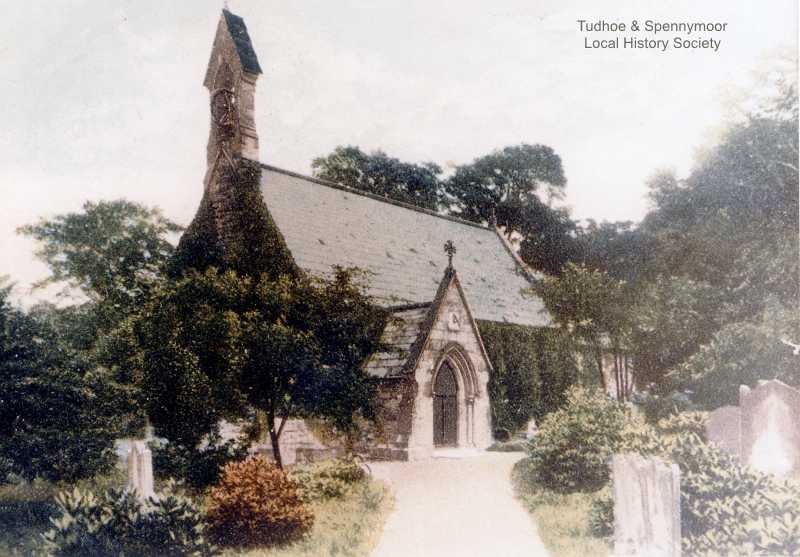 WHITWORTH CHURCH
TO BUILDERS, MASONS, &C
To Be Let by Proposal
The Masons’, Slaters, and Plasterers’ Work in the proposed Alterations and Additions of Whitworth Church. Plans and Specifications may be seen at the Parsonage, Whitworth, on and after Monday, 3rd June; and further particulars known on application to Mr. W. Nicolson, Wolsingham.
Sealed tenders to be sent to the Rev. C Carr, Whitworth, on or before Monday, 10th June, 1850. (31st May 1850 Durham County Advertiser)
TO AGRICULTURISTS, The CUMBERLAND CLOD CRUSHER may be seen at Work, at HIGH BUTCHER RACE, near Ferryhill.
Messrs PICKERING, of TUDHOE, will supply the same, at 21s each. (17th May 1850 Durham Chronicle)
William Dickinson, of Thorncroft House, Workington was a writer, botanist and geologist. He was the inventor of the Cumberland clod-crusher, a most effective and easily constructed implement.
The forge and foundry families in Cumberland were quick to spot new product outlets, opening new lines in edge-tool production – scythes, forks, spades and shovels, billhooks, hedgeslashers, and ploughshares, also turnip-choppers and chaff-cutters. Cumbria could boast well over 100 edge-tool forges. By 1850, illustrated catalogues showed all manner of tools, kitchenware, dairy goods, mowing machines, reapers, clod-crushers and harrows.
Charitable Bequests - Mr William Cook, formerly of Ferryhill, in this county, but late of Huddersfield, merchant, by his will, recently proved at York, in addition to numerous other requests, leaves to the poor of Ferryhill the sum of £10, and to the poor of Merrington, Brancepeth, Broom, and Redworth, the sum of £5 each. Towards the formation of a Reading Room at Ferryhill also, he bequeaths the sum of £19 19s., and two similar sums of £19 19s. towards the establishment of schools at the same places for the respective education of boys and girls.
Correspondent- From the above it would seem that the influence of “old associations” is likely to prove highly beneficial to Ferryhill, although with regard to the Reading Room, we believe the benevolent intentions of the testator have already been anticipated by the spirited and praiseworthy conduct of the villagers themselves. (24th May 1850 Durham County Advertiser)
Returns of Rent - At their respective rent days, held recently, Gerard Salvin, Esq., of Croxdale, and Marmaduke C. Salvin Esq., of Burnhall, returned to their tenants 10 per cent. on their rentals. (3rd May 1850 Durham Chronicle)
Charitable Donation – William Coulson, Esq., of Tudhoe, has given to such of the poor inhabitants of that village as had not the means of leading, two loads of coal each. To those who could command the use of a horse and cart, four loads were given. (31st May 1850 Chronicle Durham)
HICK v ROBINSON - This case was heard at the court held in April, but adjourned for judgement until to-day. The action was in trover, and brought by the Rev. J. W. Hick, to recover £4 10s, as damages sustained by him in the removal of a quantity of manure by defendant, the tenant of land belonging to the plaintiff. Plaintiff is the owner of land situate at Byer’s Green, which was formerly comprised in one farm, but recently divided into smaller portions. The manure in question had been left by the tenant of the whole farm, and on the division of it, had been agreed to be apportioned equitably among the several new tenants, to be laid upon their lands. The defendant being the tenant of that portion of land on which the manure unfortunately happened to be laid, thought he could take care of No. 1, and very coolly converted the whole to his own use and benefit, without thinking of his neighbours.
The court gave judgement for defendant, the plaintiff not being the proper party to sustain the action. It ought to have been brought by either the outgoing or such of the incoming tenants as sustained the loss. (25th May 1850 Newcastle Guardian and Tyne Mercury)
Accident - On Saturday last, an inquest was held at Mr John Stainbank’s, Newfield, near Bishop Auckland, before Mr Thornton, deputy coroner, on view of the body of John Owen, aged 47. It appeared that on the previous evening, about six o’clock, the deceased, who was brewer and drayman for Mr T Dibbs, of Bishop Auckland, was going in the dray from Byers Green to Newfield, when from some cause unexplained the horse set off into a gallop, and in going down the hill at Newfield, one of the barrels rolled out in front of one of the wheels, which caused the cart to upset and the unfortunate man to be thrown out.
He was found quite insensible, and removed to Mr Stainbank’s, where Mr Macfarlan, and his assistant, Mr Hardy, from Byers’ Green were speedily brought, and afterwards Mr Canney, of Bishop Auckland, attended. He was found in a state of collapse, and suffering from a compression of the brain caused by the fall. He continued perfectly insensible, and never rallied, and died on the Saturday morning about four o’clock. Verdict – Accidentally killed. (7th June 1850 Durham County Advertiser)
Merited Mark of Respect - The owners of the Harton Colliery, Shields, have just presented to Mr Coulson, of Tudhoe Hall, near this City, a beautiful coffee and tea service, for his skill and extraordinary exertions in remedying the results of a late deplorable accident there. Such a tribute is alike honourable to those who give as to him who receives it. (7th June 1850 Durham Chronicle)
In October 1854 The Times reported that Professor Airey, the Astronomer Royal, with a staff of assistants, was pursuing a series of scientific investigations in Harton Colliery, to determine some important questions with regard to the density or mass of the earth.
FERRYHILL - Mr E T Craig gave a course of three lectures before the members and friends of the Ferryhill and Little Chilton Colliery Institute, on Monday, Tuesday, and Wednesday evenings, on Phrenology, Physiognomy, and Temperaments. The lectures were highly entertaining and full of instruction. At the close of each lecture several parties submitted their heads for manipulation, and in every case Mr C gave great satisfaction in delineating the leading features of character in each. (14th June 1850 Durham County Advertiser)
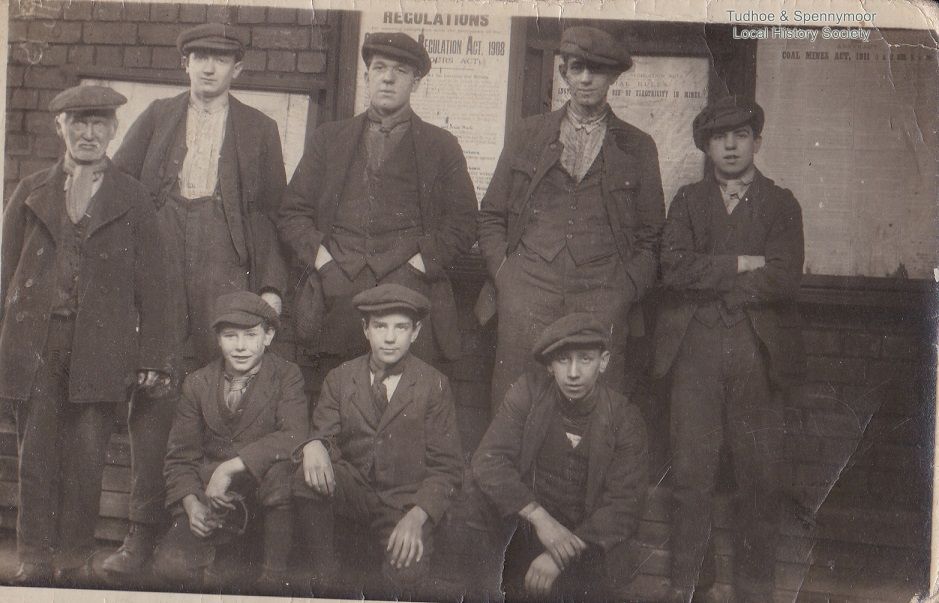 Meeting of the Miners of Northumberland and Durham. - On Saturday last, a meeting of miners of Northumberland and Durham was held on the Black Fell, near Wrekenton. The weather in the early part of the day was very unfavourable for an open-air meeting, the attendance therefore was smaller than is usual on such occasions, there being about 1000 persons present.
Mr W Bird, of Crawtrees Colliery, was called to preside, and after making a few remarks upon the importance of miners as a body, he said they had met on the hill where their forefathers were wont to assemble, to lay a plan for the protection of their labour, which was their only capital. The miners were the lowest class amongst British labourers, whereas they ought to be the highest, for they were the great bulwarks of British labour. Referring to the recent colliery explosion at Usworth, and pointing to a banner surmounted with crape, that flad he said, was an emblem of the destruction of their fellow sufferers. ……
Mr G Hodgin, of Westerton, proposed the fourth resolution –
“That in the opinion of this Meeting the only great and practical security for miners against the fearful mine accidents, is an improved system of mine ventilation, guarded and sustained by a well-organized system of government inspection, and that the government from some unaccountable cause in resisting so long the expressed convictions of the viewers and miners in all parts of England, are the indirect cause of the continued series of misfortunes and accidents that are continually bringing misery and desolation among the miners.”
All, he said, would acknowledge that an improved system of ventilation was greatly needed. At the present time, there were many collieries where there were neither wastemen nor yet a proper headway whereby the air could be properly conducted into the workings. In the return in one colliery he knew for a fact that there were only two feet square for the whole body of air for two pits. At Byer’s Green Colliery, a few days ago, the pit was in such a bad state for the want of a scientific plan to work upon, that the very drivers had to go with Davy-lamps, and the hewers refused to work, and in consequence were discharged from the colliery. At Westerton Colliery, six candles had to be “clagged” together and burnt in an horizontal position, and, notwithstanding that, the men were only able to fill one tub in four hours. With such facts as these before him it could not be denied that government interference was necessary. At Copycrooks Colliery a man was found dead in the pit a short time ago, and it was with very great difficulty that a person could go in and get him out. This system was bringing thousands to a premature grave, and during the last fifty years he had no hesitation in saying, that more than 20,000 miners had been suddenly launched into eternity.
Mr Hammond, of Trimdon Grange, seconded the resolution. When he remembered the catastrophes that had taken place in coal mines within the compass of his own recollection, he often stood appalled, and wondered that he was still in existence. The miners had long been considered a set of ignoramuses by those whom they had helped to make rich, and when they had asked for a better system of ventilation they had been mocked and ridiculed; for some time past they had applied to a higher source for remedy, but the government, although the viewers had stated their opinion that government inspection was necessary, had up to the present time refused to grant it. It was true that scientific men were occasionally sent down to examine the mines, but previous to their coming, the owners were always made acquainted with the fact that they were coming, and thus for a time the mines were improved, but no lasting benefits resulted from it.
The resolutions were all unanimously carried. (22nd June 1850 Newcastle Guardian and Tyne Mercury)
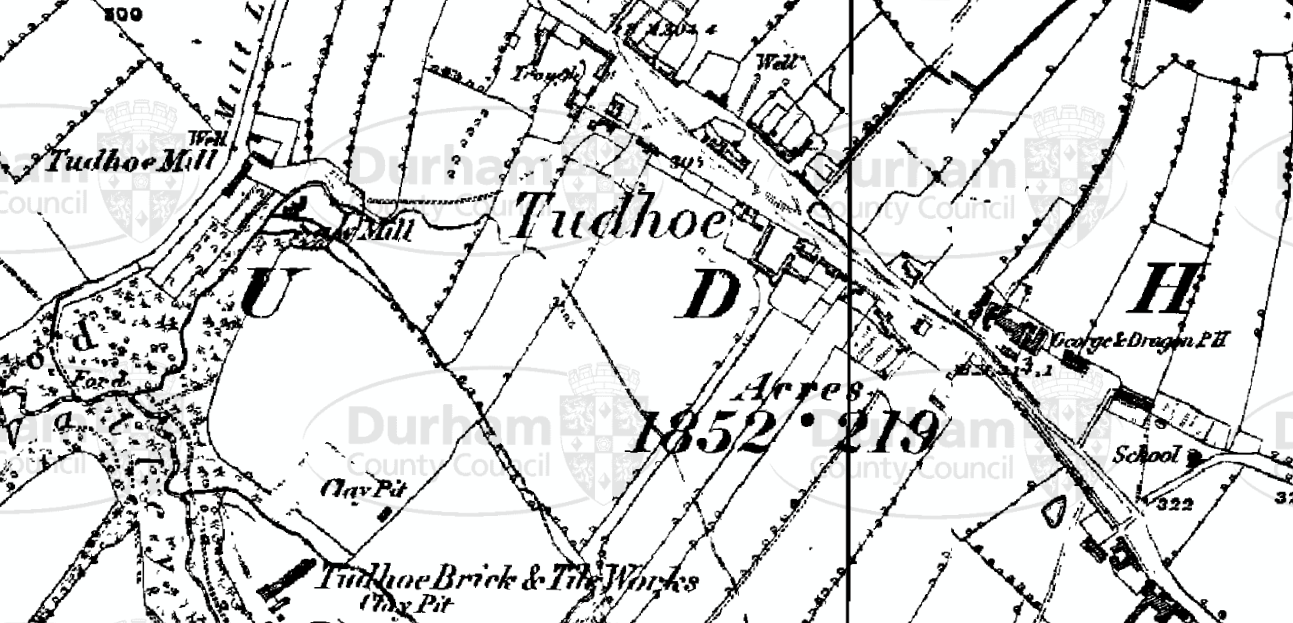 Tudhoe Brick and Tile Works
To Be Let, for one or more years, and Entered upon at the usual time in the Spring of 1851.
Further particulars may be known on application to Mr W Fleming, Tudhoe, near Durham.
Tudhoe, July 3rd, 1850.
(5th July 1850 Durham Chronicle)
Diocesan Church Societies - Quarterly meetings of the Diocesan Church Societies were held in Bishop John Cosin’s Library, Palace Green, Durham. The committee of the Diocesan Church Building Society voted grants towards building a new church at Ferryhill, on condition that the funds of the society shall be sufficiently replenished to pay those grants. (20th July 1850 Newcastle Journal)
The new St. Luke’s Church, built by George Pickering, was consecrated in September 1853, it replaced the 1820 chapel by Ignatius Bonomi.
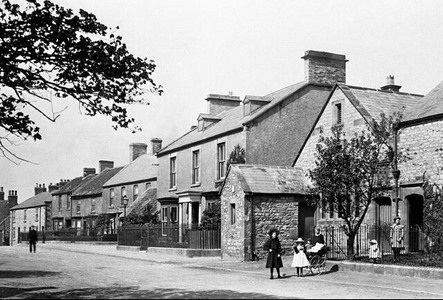
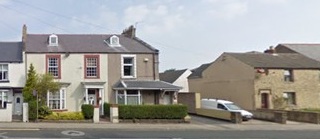 MEDICAL PRACTICE TO BE DISPOSED OF
A Small but respectable COUNTRY PRACTICE, in a pleasant District in the County of Durham.
Apply by Letter, pre-paid, addresses to T.P.T., Post Office, Ferryhill.
(19th July 1850 Newcastle Courant.)
Could this have been when two brothers moved to Ferryhill?
In 1851 there are two doctors in Ferryhill Village:-
Hugh Clark MD Glasgow, MRCP Edinburgh General Practitioner, b1819 Scotland
Donald Clark MRCP Edinburgh General Practitioner, b1829 Scotland.
In 1841 the brothers were living at Corpach, nr. Fort William, Argyll when Hugh is a medical student.
By 1861 Hugh is still living at the surgery, next to the National School in Ferryhill Village, now surgeon and general practitioner. Donald is a surgeon and has moved to High Street, Spennymoor.
In 1860 both brothers worked on the post mortem of Thomas Burns, aged 27, from Low Spennymoor who died from dislocation of the neck and pressure upon the windpipe. His parents Francis and Elizabeth Burns were found guilty of manslaughter after they were engaged in a struggle with Thomas.
Sadly Donald died suddenly on 12th August 1869, he had returned to his sitting room from the stable when he suddenly fell on the floor in a fit of apoplexy and died in a few minutes. He was a favourite as a medical practitioner and as a gentleman with his amiable and cheerful disposition, straightforward and upright conduct, and high professional attainments. On Monday 16th he was buried at St Luke’s Church, Ferryhill. “The shops in Spennymoor and Mount Pleasant were closed, and business was entirely suspended during the funeral.” (20th August 1869 Durham County Advertiser)
Hugh continued in general practice at Ferryhill until his death on 20th May 1885, he was buried at St Luke’s Church Ferryhill and left an estate of £3,157-6s-5d. He was a moderate Liberal and took an active part in the return of Sir Joseph Pease, Bart., and the Hon. F W Lambton at the election in 1880. (26th May 1885 Northern Echo)
In 1890 the surgery at Ferryhill is for sale -
Lot 6. All that substantially built Freehold DWELLING_HOUSE, with large well-paved yard, three-stalled stable, loose box with spacious loft above coachhouse with a set pot in corner, large well stocked Kitchen garden at the back and garden in front, situate at Ferryhill village, formerly occupied by the late Dr Hugh Clark and now by Dr Shirlaw. The House contains large Entrance Hall, Dining-room, Drawing-room, Breakfast-room, Kitchen, and W.C. on the first floor, and two Attics. Also all that COTTAGE adjoining. This lot forms a most commodious and desirable residential property, and is charmingly and healthfully situated, about a mile from the first class station of Ferryhill. (5th June 1890 North Star Darlington).
The photo shows the large double fronted house which is now split into two properties. To the right of it was the National School which was demolished.
Ferryhill v Chester-le-Street (True Blue) Clubs
An excellent game of cricket came off at Ferryhill, on Saturday last, between the above clubs, which terminated greatly in favour of the latter, although good playing and some excellent bowling from the other side had to be contended against. After the sports in the field the parties withdrew to the “sport” of the table. An excellent dinner was provided on the occasion by the Ferryhill Club at the house of Mr George Rudd- ample justice was done to both liquids and solids, and the company broke up at an early hour, much satisfied with the whole proceedings, but they previously entered into an arrangement for a return game to come off at Chester-le-Street at an early date.
(2nd August 1850 Durham County Advertiser)
TUDHOE FLORAL AND HORTICULTURAL SOCIETY.
The Show of this Society for 1850 will be held at Tudhoe, on Tuesday, Sept 3, when Prizes will be awarded for Flowers, Fruits, and Vegetables; and Extra Prizes for Pigs, Poultry, Eggs, and Butter.
Tickets of Admission from 2 till 3 o’clock, 1s; after that time, 6d.; Subscribers, free.
A Ball will be held in the evening.
Admission at 10 o’clock, for Subscribers and a Partner, 1s 6d.
Non Subscribers – Gentlemen, 2s 6d.; and Ladies, 1s 6d.
A Fleming, Secretary Tudhoe, Aug 28, 1850.
(30th August 1850 Durham Chronicle)
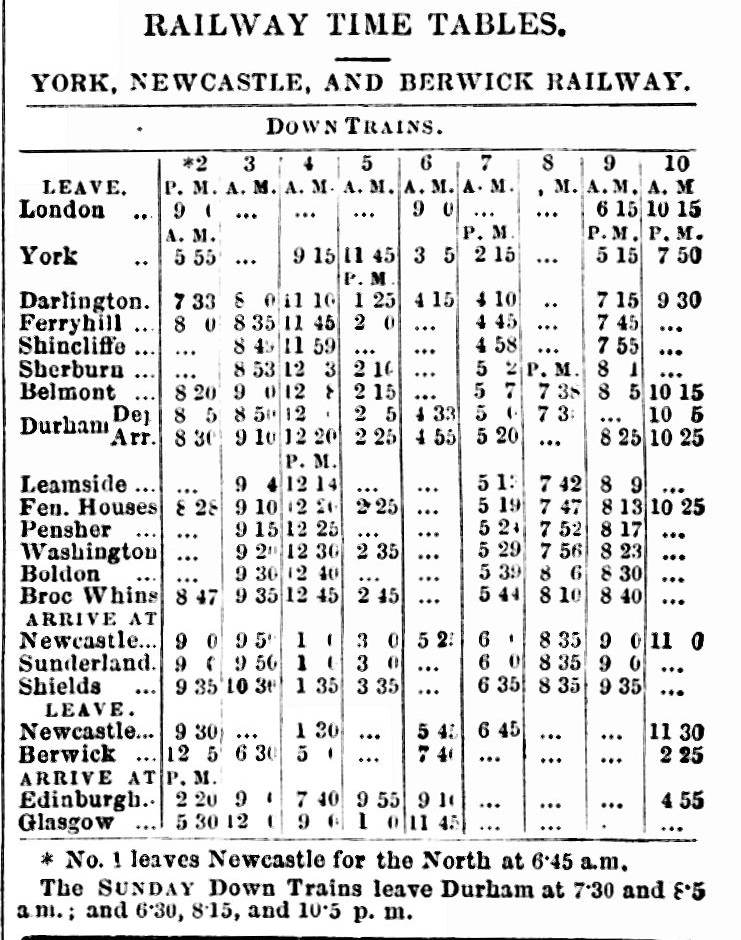
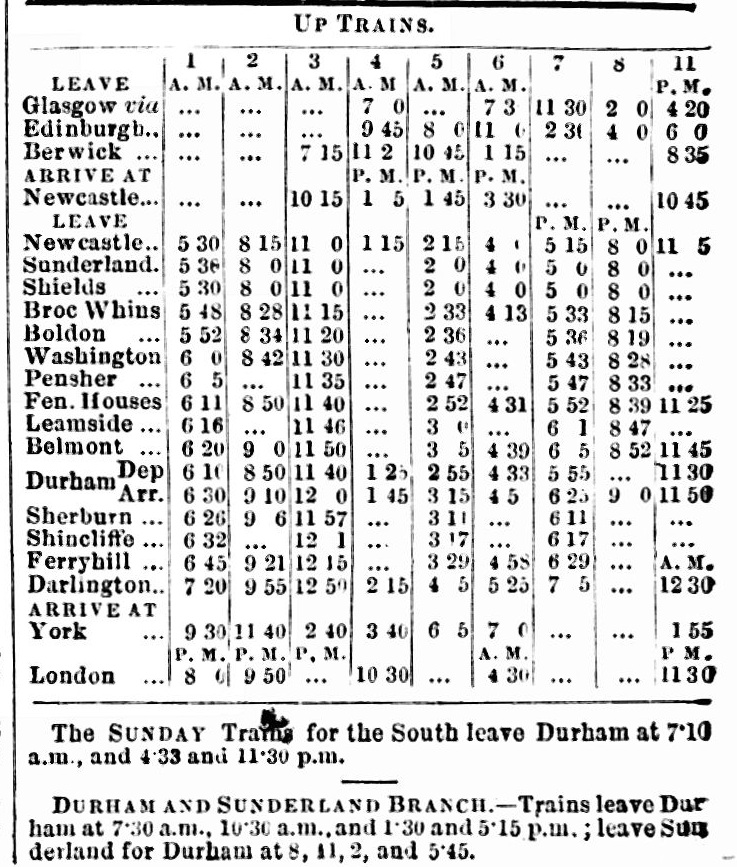
Railway Time Tables - York, Newcastle, and Berwick Railway. (2nd August 1850 Durham_Chronicle)
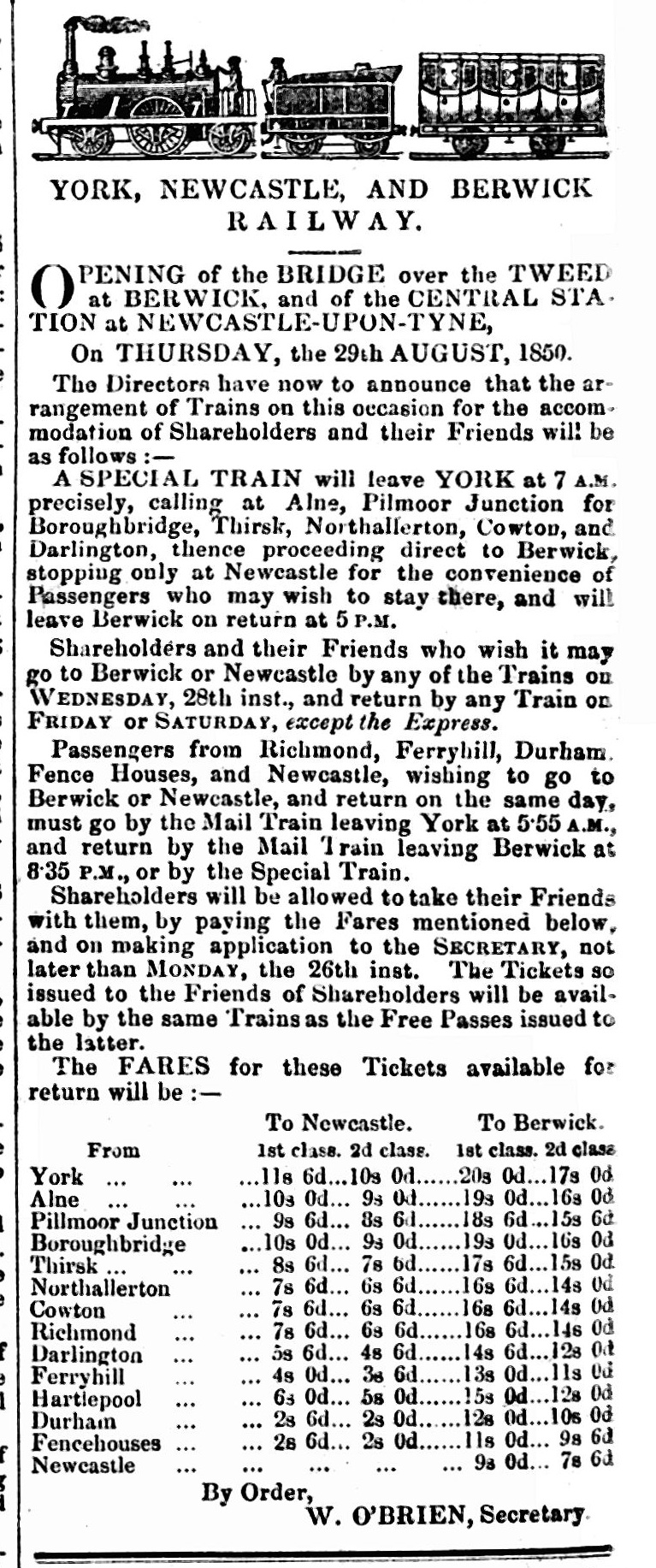 Opening of the Bridge over the Tweed at Berwick and of the Central Station at Newcastle-upon-Tyne on Thursday 29th August, 1850.(18th August 1850 Durham Chronicle)
Trip to Scarborough
On Monday, the 9th of September, there will be a TRIP to SCARBOROUGH for THREE DAYS or FIVE.
FARES- From Gateshead (9AM), North Shields (8 ½), South Shields and Sunderland (8), Durham (1/4 9),Hartlepool(1/4 7), 9s.
First, 7s Second, 5s, Third.
From Ferryhill and Darlington (10 1/2), Richmond (10), Bedale (1/4 10), Northallerton (11), 7s, 5s 6d, and 4s.
From Thirsk (11 ½), Boroughbridge (ten minutes past 12), Alne (12 1/2,), 6s, 4s, and 3s.
Children under 12, and Schools, Half-Price. Tickets may be had at all the Stations named; also the intermediate Stations.
Passengers may return from Scarborough on the Wednesday at a quarter past 12, or on the Friday at half-past 2.
Steamers will leave Scarborough on Tuesday at 9 ½, for Flamborough and Bridlington (3s, there and back);
and also for Whitby, Redcar, and Hartlepool, (3s 6d. there and back).
(31st August 1850 Gateshead Observer)
The second show of this Society came off at Tudhoe, on Tuesday last. Although only the second year of its existence, the association stands at the head of the village societies in the county, whether as regards the number of members or the amount of subscriptions. Last year the members numbered 60; this year they reached 120.
The exhibition was held in what is best known as Simpson’s school-room, which was enlarged for the occasion by pulling down a partition. The decorations were elegant and reflected great credit on the taste of the committee. The show too was a most extensive one, and the articles shown were of first-rate quality, especially the fruits and vegetables. There were numerous stands of beautiful dahlias. The fuchsias also were plentiful and good, some of them standing 7 feet high.
The collections of wild flowers were a new and pleasing feature, and that of Mr Eltingham was particularly admired. Mr Wells, of Durham, showed a stand of dwarf plants after the Chinese manner of dwarfing, which the judges particularly noticed, and on which they complimented that gentleman, who also exhibited a stand of wild flowers of great rarity, intermingled with excrescences collected from trees, bearing a marvellous resemblance to lions, lambs, cameleopards [original name for a giraffe], dogs, elephants, foxes, geese, dodos, and other animals. This excited great attention and was extremely admired. We cannot find room for the names of the plants this week.
There was a large collection of pigs and poultry, and they were generally such as to reflect great credit on the owners. Amongst the visitors, who were very numerous, were M Salvin Esq. and Mrs Salvin, G Salvin, Esq., and Mrs Salvin, Mr and Mrs Riddell, of Cheesburn Grange, Mrs and Miss Taylor, and Miss Allen, Aldin Grange, &c. &c. The best feeling prevailed among the members, and argues well for the increased prosperity of the Society.
The judges for fruit and flowers were Mr Sibbald, Bishop Auckland; Mr Modral, Whitworth; and Mr Levingstone, Castle Eden.
For pigs and poultry – Mr George Lowe, Ferryhill; Mr Richardson, Tudhoe; and Mr Morgan, of the same place.
For butter – Miss Smith, of Thorpe, near Easington, and Miss Alderson, Esh.
For the Cottage Gardens – Mr J Simes, Durham; Mr Swallow, Croxdale, and Mr John Huttoon of Burnhall.
The judges and others dined at the Black Horse; and in the evening a ball was held in the Exhibition Room. Eighty couples were present, and dancing was kept up until 6 o’clock the following morning, to the admirable music of the Auckland band.
The following is the award of prizes:-
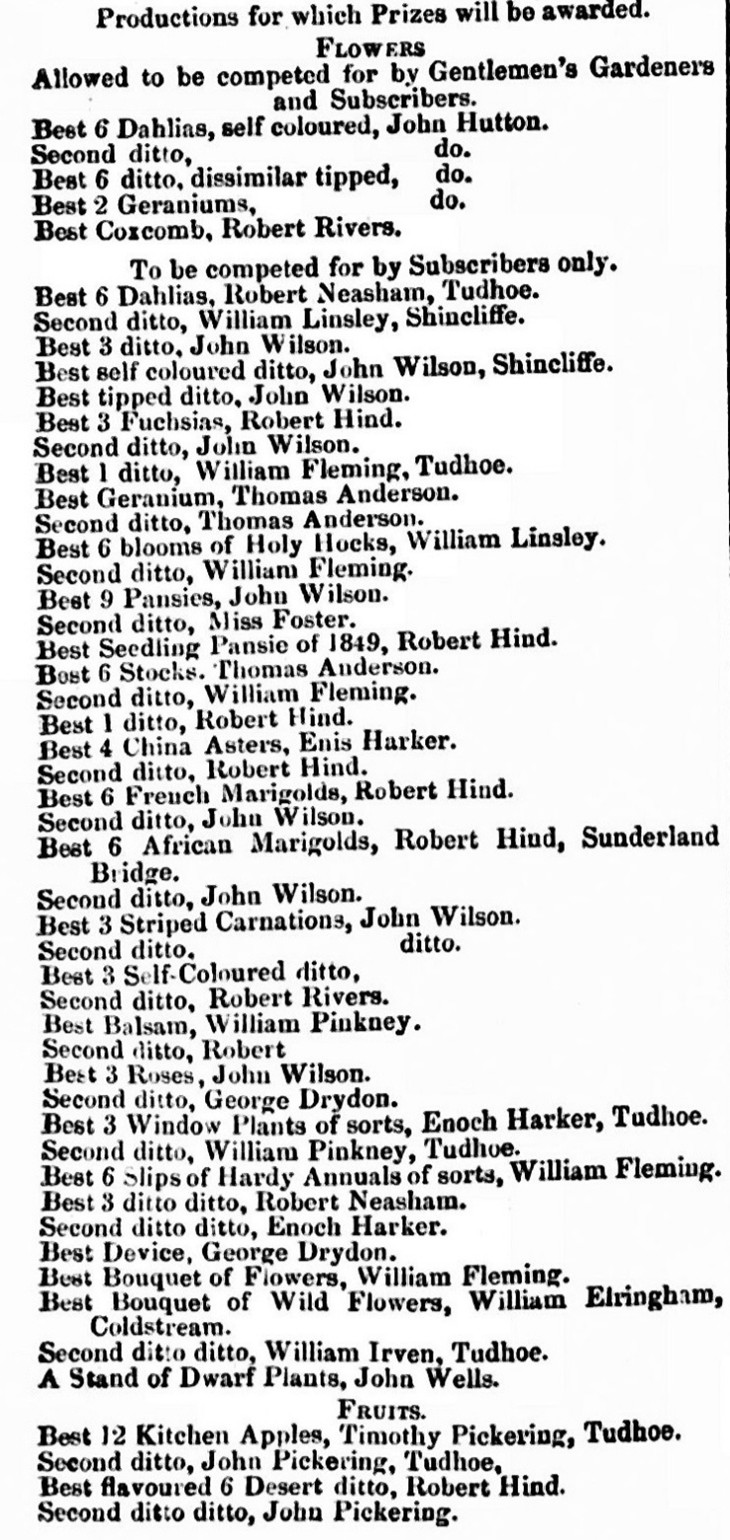
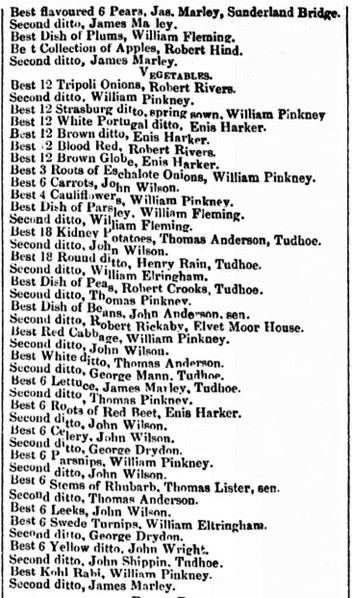
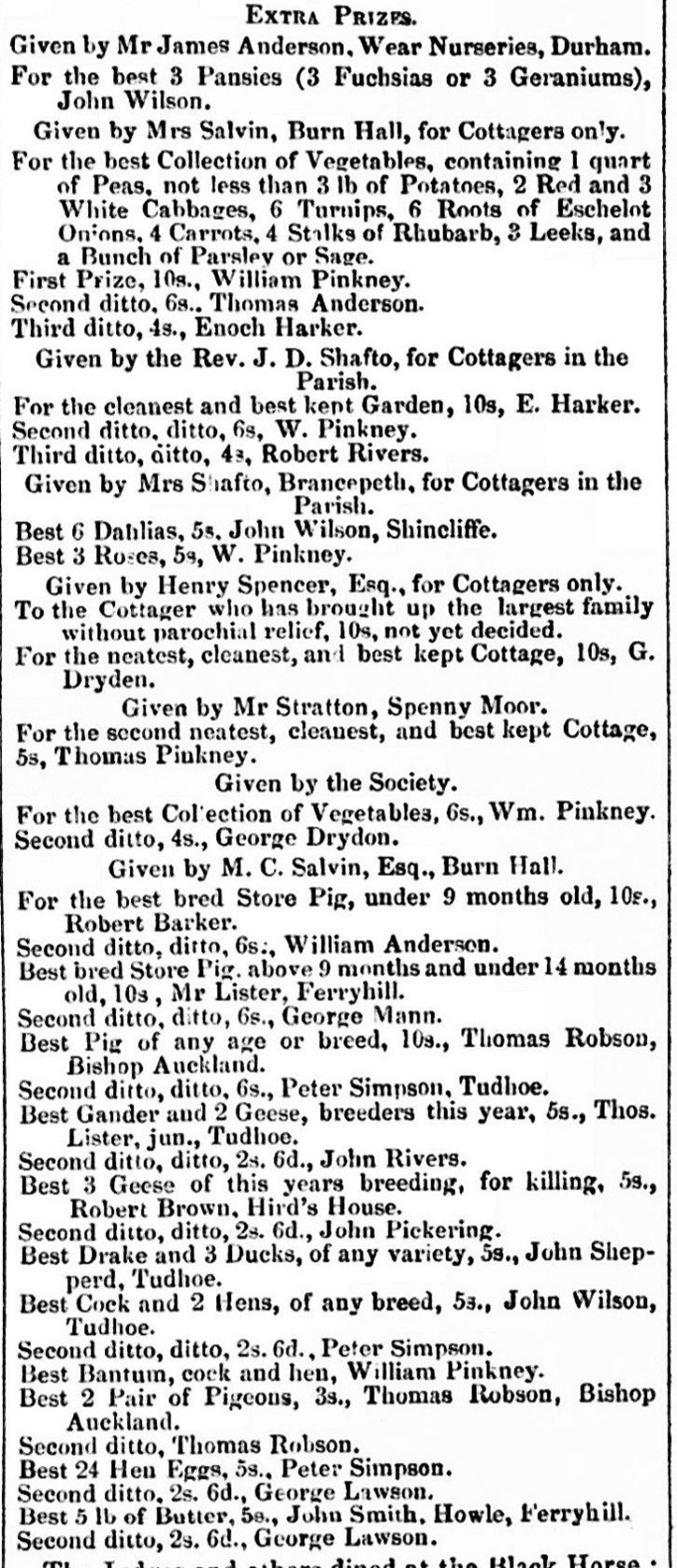
(6th September 1850 Durham Chronicle)
To Be Let
The Eatage of 14 acres of good OLD LAND FOG, at Croxdale. For particulars apply to Mr John Pickering. Tudhoe Mill, Sept 30, 1850. (4th October 1850 Durham Chronicle)
"Old land fog" refers to the vegetation, such as grass and clover, that is allowed to grow and mature on land that has been left fallow for a period. The term "fog" in this context refers to coarse, uncut grass, and "old land" signifies the land's previous state as an established pasture.
Farmers would use "old land fog" as a source of feed for their animals, especially if other, better quality forage was unavailable. The quality of "old land fog" was often inferior to more actively managed pastures, but it was a practical source of roughage. (AI description).
Durham County Agricultural Society
For the best Three-year-old Colt for Harness, £2.
George Morgan, Tudhoe, near Durham. Bred by himself. (4th October 1850 Durham Chronicle)
Extraordinary Crop of Turnips
Mr Thomas Anderson, of Tudhoe, near this city, has about two chains of Swede turnips which average from twenty-one to twenty-four inches in circumference. (4th October 1850 Durham Chronicle)
Prize Bull
It is stated that Mr Trotter, of Bishop Middleham, has sold his prize Bull, “Sussex”, to an agent of Baron Rothschild, at a great price. The bull left Ferryhill Station yesterday week, en route for Germany. (12th October 1850 Newcastle Journal)
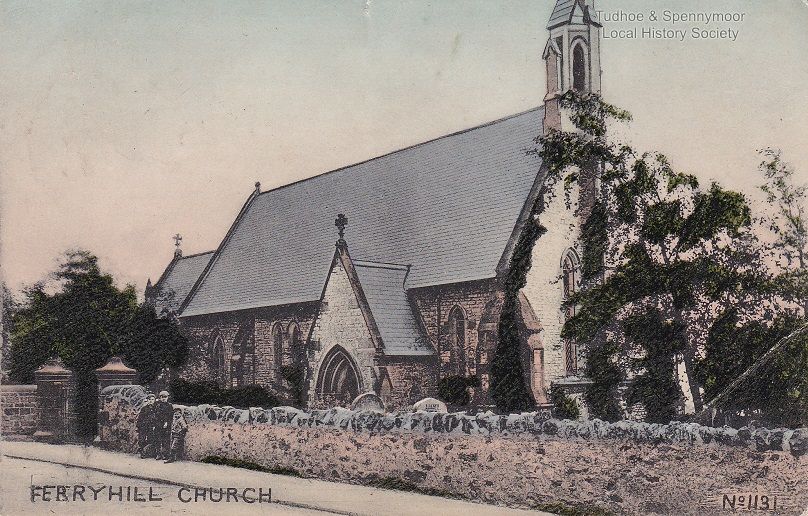 New Church at Ferryhill
The Rev. D Bruce, Curate of Ferryhill, seconded by his church wardens, is making endeavours to raise funds for a new church at that place; the donations already amount to nearly £700.
The old church is most inconveniently situated, and is in a very dilapidated state. ( 2nd November 1850 Newcastle Journal)
The new St. Luke’s Church, built by George Pickering, was consecrated in September 1853, it replaced the 1820 chapel by Ignatius Bonomi.
Poaching at Tudhoe.
On Saturday afternoon last, as John Dawson, watcher for M C Salvin esq., Burn Hall, was going his rounds on Mr Salvin’s grounds near Tudhoe, he came upon two parties names John Bell, and Christopher Bell, of Byers Green, who were using nets and ferrets for the purpose of catching rabbits. On attempting to secure them, Dawson was very severely maltreated. They have since been brought before the County Magistrates, charged with the double offence of trespass and assault, when they were fined 40s each, and in default committed to the house of correction for two months.
(15th November 1850 Durham Chronicle)
Bowes and Sunderland Bridge Turnpike Road Tolls to Let.
Notice is Hereby Given, that the Tolls arising at the several Toll Gates and Bars upon the above mentioned Turnpike Road, called or known by the names of Boldron Gate, Dunhouse Gate, Keverston Bar, Sun Bar, Evenwood bar, Cabin Gate, Westerton Gate, and Coundon Bar.
WILL BE LET BY AUCTION,
To the highest Bidder, at the House of Mr Seaward, Talbot Inn, Bishop Auckland, on Thursday, the 21st day of November next, at 12 o’clock at noon, in the manner directed by the Acts passed in the 3rd and 4th years of the Reign of His late majesty King George the Fourth, for regulating Turnpike Roads, which Tolls are let during the current year for the several Sums following, viz.:-
Boldron Gate ...........£100
Dunhouse Gate .........230
Keverston and Sun Bars .76
Evenwood Bar .............65
Cabin Gate ................190
Westerton Gate ..........240
Coundon Bar ...............30
These Tolls will be Let for the term of One Year, to commence on the 1st day of January next, and will be put in Parcels or Lots, and at such Sums as the Trustees shall think fit.
Whoever happens to be the highest Bidder must give security, to the satisfaction of the Trustees of the said Turnpike Road, for the payment of the Rent at which such Tolls shall be let, by equal monthly payments, and no person will be allowed to bid whose sureties are not approved, and present at the letting to enter into the necessary Contracts.
John Dickonson Holmes,
Clerk to the Trustees of the said Turnpike Road. Barnardcastle, October 16, 1850.
(1st November 1850 Durham Chronicle)
Bowes and Sunderland Bridge Turnpike Trust 1747 - Durham Roads Act 1747
An Act for repairing the High Road from the Town of Bowes, in the County of York, to Barnard Castle, in the County of Durham, and from thence, through Staindrop, to Newgate, in Bishop Auckland, and from Newgate, along Gibb Chair, to Gaunless Bridge, and from thence, by Melderston Gill, otherwise Coundon Gill, to the Turnpike Road near Sunderland Bridge, in the County of Durham.
Boldron Gate is on the Bowes to Barnard Castle Road. The other Gates are shown on the map.
Turnpikes between Barnard Castle and Westerton.
Ferryhill and Little Chilton Institute
Ferryhill. Yesterday week the Committee of the Ferryhill and Little Chilton Institute held their quarterly meeting; the results of their labours were very satisfactory, only one member having left the library throughout the year, with the exception of those that had removed from the neighbourhood. It was resolved that the annual soiree be held in the first week of January next, after re-appointing their secretaries., Mr Thomas Bramley for Chilton, and Mr Thomas Bland for Ferryhill, the meeting was concluded by a vote of thanks to the Rev. D Bruce, the chairman.
(15th November 1850 Durham Chronicle)
To Schoolmasters. Wanted, immediately after Christmas, a Master and his wife, to conduct a Wesleyan Day School in a Colliery Village, to whom will be given a School Room, with House and Firing free.
For further particulars apply to Mr C A Baker, Park Hill, Ferryhill.
(15th November 1850 Newcastle Courant)
TO BE LET BY PROPOSAL
And entered upon at May-Day next, or at the usual times in the Spring,
All that Farm called “East Rufflee”, Ferryhill, now in the occupation of Messrs Carr, containing 133 acres, or thereabouts.
This Farm has nearly all been thoroughly drained.
Encouragement will be given to a tenant of capital and skill.
Mr Thomas Laverick, of Ferryhill, will show the Farm, and give every information, as well as receive offers for the same till the 15th day of Jan. next.
Bishop Auckland, Dec 18, 1850 (20th December 1850 Durham Chronicle)
East Roughlea farm is accessed by a track to the south of Dean Bank Old People’s Homes on the Merrington Road.
To Be Let At Ferryhill, in the County of Durham.
FOUR FIELDS, now in the Occupation of Mr Michael Brown; Two of which 16A, 1R, 31P, are in Tillage; the remainder 8A, 1R, 37P, in Old Grass.
One-third of the Tillage, (which is excellent Turnip and Potato Soil) may be entered upon at Candlemas, 1851, and the Grass Land on the 13th Day of May following.
For further Particulars apply to Mr John Booth, Sherburn Grange, near Durham.
Sherburn Grange, Dec 19th 1850. (20th December 1850 Newcastle Courant)
FARM TO BE LET, TITHE-FREE, ON LEASE OR OTHERWISE, And entered upon at May-day, 1851.
FAREWELL HALL WEST FARM, in the Township of Elvet Barony, Durham, containing 157 Acres, more or less, of Arable, Meadow, and Pasture Lands (part of the Tillage Land laving been drained), situated about 1.5 miles from the City of Durham, on the Darlington Road.
Further particulars may be known on application to Wm. Fleming, Land Agent, Tudhoe, Durham.
Tudhoe, 24th Dec., 1850.
(27th December 1850 Durham Chronicle)
WANTED, by a Young MAN, a SITUATION in the GROCERY BUSINESS, who has been Five Years in the Trade. Address by Letter to A.Z, Mrs White, Ferryhill. (20th December 1850 Newcastle Courant)
Inquest - John Maddison
An inquest was held on Monday at Ferryhill, before Mr Trotter, on the body of John Maddison, who had been working as a banksman at Little Chilton Colliery. It appeared that the deceased was walking along the gangway which leads to the apparatus separating the small coal; the way being covered with ice, and slippery, it was thought he had slipped, for he was seen to fall over the wall top into a coal-waggon, and the back part of his neck came in contact with the wagon top. He would fall about ten feet from the wall upon the wagon. The deceased was immediately removed home, where he died shortly after. No one was with the deceased when the accident happened.
Verdict – “Accidentally killed”.
(7th December 1850 Newcastle Journal)
The Weardale or Mountain Lime
Perhaps it may not generally be known amongst the agriculturists and gardeners of this neighbourhood, that the Weardale limestone can now be brought to the railway station at Durham, at about the same cost as the magnesian lime can be procured from the quarries in the vicinity. When the superior quality of this lime is taken into consideration, this will be found to be a matter of no trifling importance to those engaged in the cultivation of the soil.
From a table of analysis made by Professor Johnston, Sir Humphrey Davy, and other chemists of eminence, it appears that the grey shell Weardale lime contains 95.1, and the hard blue 93.8 of carbonate of lime; whilst the Eldon lime contains but 46, the Aycliffe 44, Ferryhill 54.1, Hartlepool 54.5, and Carlbury 79 parts respectively.
Professor Johnston also says “That the small quantity of magnesia present in the mountain limestone of Weardale is an advantage in an agricultural point of view, since the plant requires for its healthy growth a certain minute proportion of magnesia which this lime will be able to supply. The evil of magnesian limestones, properly so called, is, that they contain so much more magnesia than is necessary to supply the wants of the plant as actually to prove hurtful to its growth”.
The grey shell of Weardale contains but 2.5, and the hard blue 0.4 of carbonate of magnesia. The means of cheaply procuring this desirable fertilizer has been brought about by the liberality of the Railway authorities, and there is no doubt will be duly appreciated.
One gentleman in Durham who has already obtained three waggon loads by way of experiment, states that the price charged him at the station does not exceed that of procuring and leading it from the neighbouring kilns, - namely, 7s, a horse load.
(28th December 1850 Newcastle Journal)
BYERS GREEN
The Bishop of Durham, with his accustomed liberality, has given £15 towards the Church Schools in the parish of Byers Green; and likewise £20 towards supplying the village with water. (20th December 1850 Durham Chronicle)
Extraordinary Run With The Durham County Fox-Hounds
The meet was at Whin-houses on the 14th, which cover was drawn blank. The hounds were then taken to Blue House cover, where they soon gave information that reynard was afoot. The hounds broke away in gallant style to the North, through Dropsell plantation, crossing Hurworth Burn, away for Lord Howden’s plantations; but, turning short, bore away for Hartbushes, leaving the colliery on the left.
They then came round by Black Hurworth, crossing Hurworth Burn, and back to his old lair: this run kept the horsemen very busy for 35 minutes. After casting about for 10 minutes, the gallant old fox bounded up in front of the hounds, where he had taken rest in a stubble. He now took the same course as far as Dropsell, but, being hard pressed, changed his route, and broke away for Trimdon; being headed, he turned to the left, pointed away for Greenside cover, leaving Fishburn to the left, turning to the right by Trimdon House, away for Garmondsway Moor, but being again headed turned back again, crossing the road for Camp Whin, and the Durham turnpike near to the Hare and Hounds, away for Mainsforth plantations, down by Thrislington, crossing the North of England Railway.
Here the scene may be better imagined than described; reynard climbing the steep hill, the hounds in the valley, old Nimrod a few paces in advance, all sending forth their sonorous notes; and the few noble steeds that were left descending the hill from Thrislington. Reynard now took his route by Ferryhill, but being headed, turned down by the Howle, crossing the Byers Green Railway, away for Thinford Mill, then turning to the left made away for Butcher Race.
It now became evident that he was weary of his indefatigable pursuers, and he turned again to the right, and made for Hett. Here the hounds came in view, and the gallant old fox made a valiant struggle, and coming into some very small enclosure once more escaped their view. He now made for Tursdale Beck, but turned back, made for Croxdale Hall, through the park, and turned for High Croxdale, with the invincible pack almost close on his brush.
The earths here being open he got to ground, after running one hour and forty-five minutes, making altogether two hours and twenty minutes. The run is supposed to have been upwards of 30 miles. (20th December 1850 Durham Chronicle)